
How to Clean Breast Pump Parts Correctly (CDC Guidelines, Step by Step)
Germs can grow quickly in breast milk residue left on pump parts, which is why the CDC publishes a specific method for keeping a pump kit clean. It is not complicated, but the details matter. This is the routine, step by step, following the CDC's current guidance: How to Clean and Sanitize Breast Pumps (CDC).
Before you pump
- Wash your hands with soap and water.
- Inspect the kit as you assemble it. If tubing looks moldy, discard and replace it — tubing cannot be cleaned well enough to keep using.
- If you use a shared pump, wipe the dials, power switch and countertop with a disinfectant wipe.
After every use — the cleaning steps
- Store the milk first: cap the collection bottle or seal the bag, label it with the date and time, and refrigerate or freeze it right away.
- Take the kit apart, separating every part that touched your breast or milk.
- Rinse each part under running water to remove milk residue. Do not rest parts directly in the sink.
- Wash as soon as you can, one of two ways: by hand, in a wash basin used only for pump kits and infant feeding items (not the sink itself), with hot, soapy water and a brush kept for that job alone; or in the dishwasher, if the parts are dishwasher-safe, on hot water with a heated drying cycle, with small pieces in a closed-top basket or a mesh bag.
- After hand-washing, rinse under running water and place parts on a clean paper towel or a clean, unused towel to air-dry. Do not rub or pat them dry with a dish towel — that can transfer germs back onto clean parts.
- Wash the basin and brush too, and let them air-dry. Clean them in the dishwasher or with hot, soapy water regularly.
One popular shortcut to skip: putting used parts in the refrigerator to deal with later. Refrigeration slows bacteria but does not stop them, and the CDC does not treat rinsed, refrigerated parts as a safe substitute for washing after every use.
Sanitize once a day
Cleaning removes milk residue and most germs; sanitizing is the extra step that removes more. The CDC recommends sanitizing pump parts at least once a day, and says it is especially important when your baby is younger than 2 months, was born prematurely, or has a weakened immune system.
Use whichever method fits your parts and the manufacturer's instructions:
- Boil: place parts in water and boil for 5 minutes.
- Steam: use a microwave steam bag or an electric steamer made for pump parts.
- Dishwasher: run a hot-water cycle with heated drying, or use the sanitize setting.
Wash your hands before you take sanitized parts out, and let them air-dry completely on a clean surface.
Store parts dry — never damp
Only put parts away once they are completely dry; damp parts stored in a closed space are where mold grows. Keep them in a clean, protected spot — a covered container reserved for feeding items — until the next session.
Where a bottle washer fits in
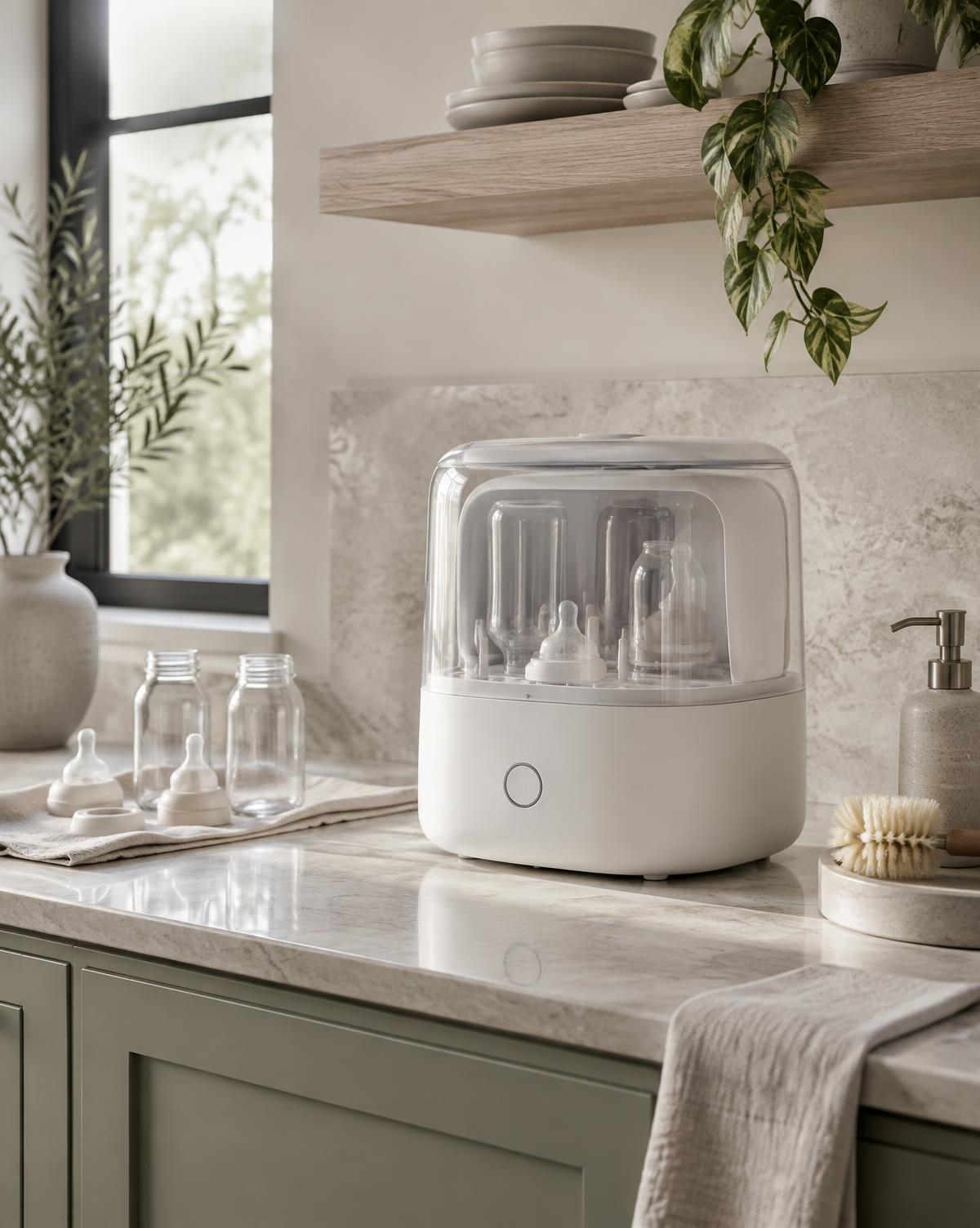
The method above is the standard, whatever tools you use. A countertop system like MOOBBI Wash exists to run the wash, sterilize and dry sequence as one cycle — the same jobs, without the basin-and-rack routine at every session. What matters is that every part is cleaned after every use, sanitized daily, and stored fully dry.
Setting up a night routine around pumping and bottles? Read The 3 A.M. Feed: A Night-Feeding Routine That Actually Works.
Source: Centers for Disease Control and Prevention, "How to Clean and Sanitize Breast Pumps" — https://www.cdc.gov/hygiene/about/about-breast-pump-hygiene.html (accessed October 2026).