
Bottle Washer vs Dishwasher: Can a Dishwasher Actually Sterilize Baby Bottles?
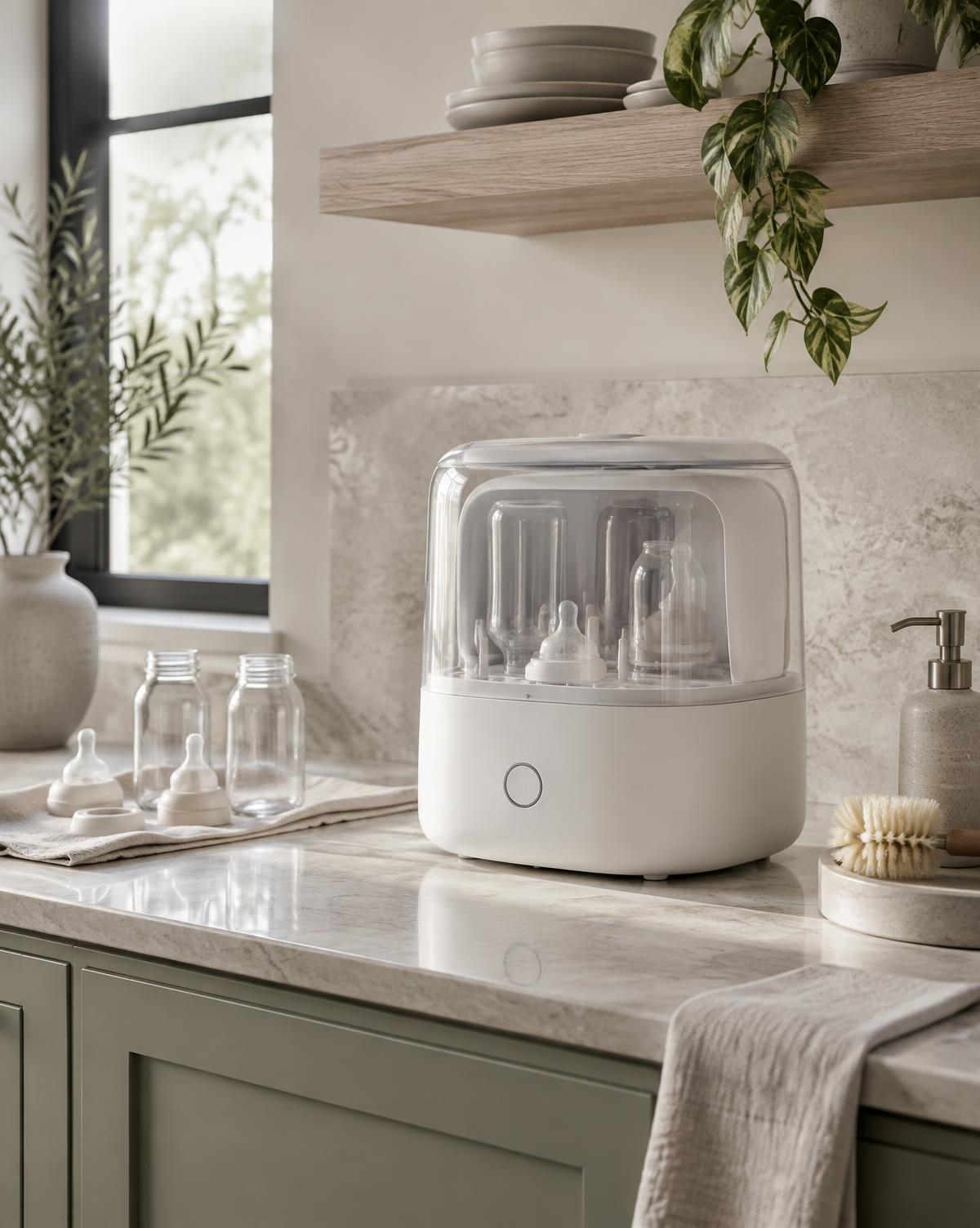
It is the first question almost every parent asks before buying any feeding gadget: the dishwasher already washes things — why would bottles need their own machine? The honest answer has two parts. A dishwasher can be part of a safe routine. And washing and sterilizing are not the same job.
The short answer
Washing removes milk residue and most germs. Sanitizing — what parents usually mean by sterilizing — is the extra step that kills what washing leaves behind, and the CDC treats it as a separate step: clean after every use, and sanitize daily, which matters most for babies under 2 months old, babies born prematurely, and babies with a weakened immune system. A dishwasher only covers that second step if it runs a hot wash with a heated drying or sanitize cycle — and only for parts that are dishwasher-safe and loaded so water actually reaches them.
What a dishwasher does well
- Volume: a full day of bottles and pump parts in one load, with nothing new to buy.
- Heat: a hot wash with a heated dry or sanitize cycle can sanitize dishwasher-safe parts — the CDC lists the dishwasher as a valid way to clean feeding items when it is used this way.
- Cost: it is already in your kitchen. For many families with older, healthy babies, careful dishwasher cleaning is enough.
Where it falls short for feeding gear
- Timing: bottles are needed every few hours, but the dishwasher runs on the household's schedule — the part you need at 3 a.m. is usually still in last night's load. (It is exactly the gap a night-feeding routine has to plan around.)
- Small parts: nipples, valves, membranes and vent tubes flip over, fill with dirty water, or end up on the heating element.
- Mixed loads: feeding items share the cycle with dinner plates, and with detergent chosen for grease — not for milk residue in a newborn's bottle.
- The sanitize gap: without a sanitize or heated-dry cycle, a standard or eco wash cleans but does not sanitize.
- Drying: parts often come out wet and finish on a rack — and the rack step is the one that gets rushed at midnight.
What a dedicated bottle washer changes
An all-in-one bottle washer runs the whole sequence — wash, steam-sterilize, dry — in one closed cycle, on the counter, on the feeding schedule instead of the kitchen's. Nothing is shared with dinner, small parts have fixed places, and the load finishes dry instead of on a rack. That is the job MOOBBI WASH was designed for — US$279, arriving March 2027. It is also what the machines in our buyer's guide do today.
So which do you actually need?
- The dishwasher is enough if: your baby is older and healthy, your machine has a sanitize cycle, and you own enough bottles to bridge a full load.
- Add a sterilizer or a washer if: your baby is under 2 months, premature or immunocompromised, you pump several times a day, or the sink-and-rack routine is eating your evenings.
- Either way, the method matters: our step-by-step guide to how to clean breast pump parts follows the CDC method in full.
Sources: CDC, How to Clean, Sanitize, and Store Infant Feeding Items and How to Clean a Breast Pump, checked November 19, 2026. Dishwasher sanitize performance varies by model — check your manual for a sanitize or heated-dry cycle.